
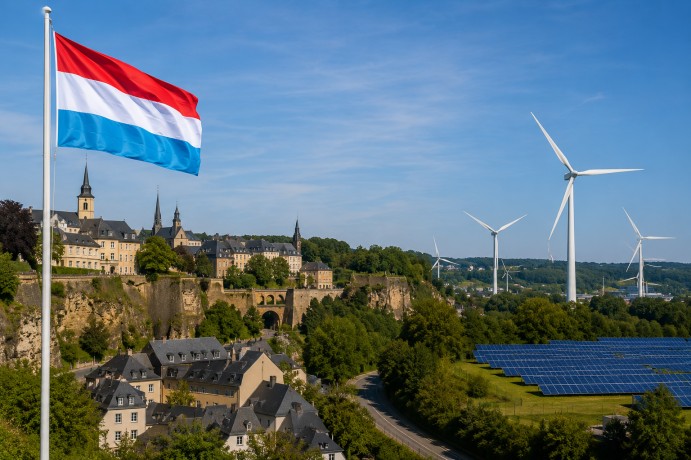
Despite a consistent rise in renewable energy usage across the European Union, Luxembourg found itself among the bottom three member countries for renewable electricity consumption in 2025, according to recent data from Eurostat. Renewable sources constituted 20.2% of Luxembourg’s gross final energy consumption, positioning the country as one of the lower performers in the EU. Specifically, only 23.3% of Luxembourg’s gross electricity consumption was derived from renewable sources, surpassing only Czechia and Malta in this regard.
The broader EU picture paints a more optimistic scenario, with renewable energy representing 26.2% of the bloc’s gross final energy consumption in 2025. This marks a significant increase from 9.6% in 2004, reflecting the EU’s ongoing transition towards greener energy solutions. The European Union has set an ambitious target to elevate this share to 42.5% by the year 2030, underscoring its commitment to sustainable energy development.
Leading the charge in renewable energy consumption is Sweden, where an impressive 65.4% of the nation’s overall energy consumption is sourced from renewables. Closely following Sweden are Finland and Denmark, both of which have also made substantial strides in integrating renewable energy into their national grids. These countries exemplify the advances being made within the EU towards a more sustainable energy future.
When it comes to renewable electricity, Austria emerges as the frontrunner, with over 90% of its electricity derived from renewable sources. This achievement highlights Austria’s significant progress in renewable energy adoption, setting a benchmark for other EU nations to emulate. Austria’s success in this sector is indicative of the broader shift within the EU towards cleaner energy production, which is crucial for meeting the bloc’s future environmental goals.